The Plague by Albert Camu
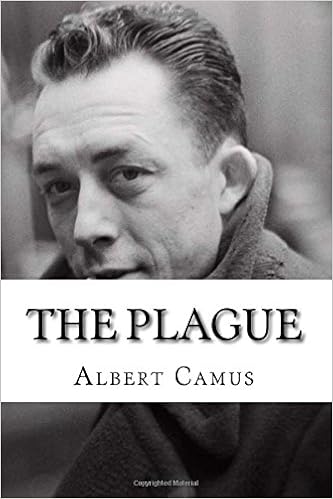
The Plague by Albert Camus
Characters:
- 1. Dr. Rieux
- 2. Jean Tarrou
- 3. Rambert (Journalist)
- 4. Father Paneloux
- 5. Grand
- 6. Cottard
The Story:
In a town named Oran at the cost of Algeria rats start coming out of hiding and dying on the streets, alleys, factories and houses. The management of the town issues order of the daily sweep and soon the number of rats carried away by the workers starts dropping. As the rats disappear, people in the town start developing a fever that within days takes the life of the individual. Dr. Rieux his colleagues and friends put up a struggle against the fatal fever and in due course come to know how their lives unfolded prior to the fever.
Thesis Statement:
The novel addresses two things most crucial to the “Human Experience.” These being Death and Struggle. Camus notes that death cannot be subtracted from the human experience and that death entails us even in a lover’s arms or out roaming the streets conducting everyday business. Neither can struggle be subtracted from this experience. Humans always put up a fight, they may run and retreat back to their homes but nonetheless they will eventually fight back. Though these two might seem at a contrast, that no matter if we put on a fight or not death will have its grim, bony hands on us, they are what makes us human.
Camus in the early pages of his novel writes “Our citizens work hard, but solely with the object of getting rich. Their chief interest is in commerce, and their chief aim in life is, as they call it, “Doing Business.” And Camus goes on to tell that the people don’t eschew on “simpler pleasures” like love making, sea bathing and going to pictures. Camus says that most of the people of the town are busy five days a week in this act of “Doing Business” and on Saturdays and Sundays at a specific hour they gather in cafes and pubs to drink and gamble. Camus further writes that “men and women consume one another rapidly in what is called the act of love… At Oran, as elsewhere, for lack of time and thinking, people have to love one another without knowing much about it.”
This how Camus see the world we live in. We exhaust ourselves working from morning till night and have very little or no time to glance our our surroundings let alone the people that are around us. This level of involvement is rather blinding and results in us rarely making something something useful of our lives. Only when, Camus challenges us, death is upon that we open our eyes from this slumber and realized life has already crossed and death is at our door and we ourselves not able to do anything about it. At another stage Camus writes “everybody knows pestilences have a way of recurring in the world; yet somehow we find it hard to believe in the ones that crash down on our head from a blue sky. There have been as many plagues as there have been wars in history; yet always plagues and wars take people equally by surprise.”
It is here that Camus presents a serious challenge to the human thought. Why is it that we are always taken aback by wars breaking out and plagues laying siege to a town. Death is nothing new to the human conscience but every time it is able to take us in surprise. To put it simply, we are always busy. We are always busy conducting business that death is at our door. Or it would be right to say that death, from the moment of our birth, is with us and we involve ourselves in tasks that we forget our long lost friend and when he knocks on us we are shocked. IT is to say that death is always with us, at the best of our times and at the worst of our times it is with us.
Posing these questions, Camus turns his attention towards the struggle man puts himself in often in times of plagues and wars. In one of his conversations with Tarrou, speaks of women who would not give up in the face of death. Camus writes "Do you know that there are some who refuse to die? Have you ever heard a women scream 'Never!' with her last gasp?" It is as if the novel presents that calamities will always be present and will walk beside us and often come when we least expect it . And the novel also presents that man must always put on a fight against them. Camus writes that plagues under their despotic rule have no respect for person or rank. Under them all are same and this is exactly the reason why man puts up his struggle. Our lovers and our loved ones, those who we long for are all under its rule and will go through the same pain and anguish. That is why he writes "but what if he ceases caring for anything outside that, what's the use of his fighting?"
"And to state quite simply what we learn in time of pestilence: that there are more things in men to admire than to despise."
Disclaimer:Image taken from "https://images-na.ssl-images-amazon.com/images/I/410EfCGarDL._SX331_BO1,204,203,200_.jpg"


Comments
Post a Comment